Many States Regulate the Scanning of ID Barcodes; Why Don鈥檛 They Offer Similar Protections for Digital Driver鈥檚 Licenses?
Digital driver鈥檚 licenses 鈥� now being built in many states 鈥� have a big problem that almost nobody is addressing: the likelihood that once they make it very frictionless to share our ID, we are likely to be bombarded by requests from all quarters to prove who we are. That鈥檚 a huge threat to our privacy. There is, however, a set of existing laws in the states that point to a solution for this problem: regulations governing who may scan the bar codes on physical IDs.
Digital driver鈥檚 licenses threaten to become unique identifiers that force us to reveal our identity to all manner of parties whether we want to or not, allowing us to be inescapably tracked. Companies today don鈥檛 usually demand that customers prove their identity unless they really need to, because it鈥檚 too much of a hassle and too big of an ask that will scare away too many customers. But when you can just serve website visitors a popup that says 鈥淐lick here to share your ID,鈥� everything changes. It would give government and companies more power over ordinary people 鈥� and often in unpredictable ways. For example, I recently explained how digital IDs will facilitate 鈥�surveillance pricing,鈥� in which companies charge us different prices than other people based on what they know about us through tracking and surveillance of our activities and characteristics.
Any state or government that creates a digital ID needs to address this problem by making sure that people can say 鈥渘o鈥� to requests for digital IDs that are not absolutely necessary. But with the exception of and , none of the approximately 17 states that have created digital driver鈥檚 licenses have begun to address the significant dangers to privacy, access, and user control that these systems threaten to create.
What would a protection against such demands look like?
The existing regulations in many states that create protections around the bar codes printed on physical licenses are a good place to start. Machine-readable barcodes have been a sort of proto-digital ID: they allow quick and automated digital collection of all the data on your ID, albeit mostly in person. Abuse of barcode scanning has been a in many states across the nation, for example at bars that scan IDs for the ostensible purpose of verifying age, but then collect far more data than the binary 鈥渙ver 21 yes/no鈥� data bit they need.
Bar codes were mandated on driver鈥檚 license by the misbegotten post-911 , and many of the protections against scanning were enacted in the years after Real ID came into effect and, I suspect, in response to the act, which was unpopular across the political spectrum and sparked an in numerous state legislatures.
Based on information from online and some initial research of our own, it appears that 17 states regulate either when businesses may scan the bar code on a physical ID, how data from such scans may be retained or otherwise handled, or both. For example:
- Texas law it is an offense if a person 鈥渁ccesses or uses鈥� digital information 鈥渄erived from a driver's license,鈥� or 鈥渃ompiles or maintains a database of electronically readable information derived from driver's licenses鈥� or similar IDs.
- New Hampshire law 鈥渘o person shall scan, record, retain, or store, in any electronic form or format, personal information obtained from any license鈥� unless authorized by the state鈥檚 Department of Safety, which contains the state鈥檚 DMV.
- New Jersey鈥檚 law limits scanning and data dissemination to an enumerated list of permitted uses, and regulates data sharing. And the state鈥檚 new law authorizing digital driver鈥檚 license the old scanning law to digital driver鈥檚 licenses.
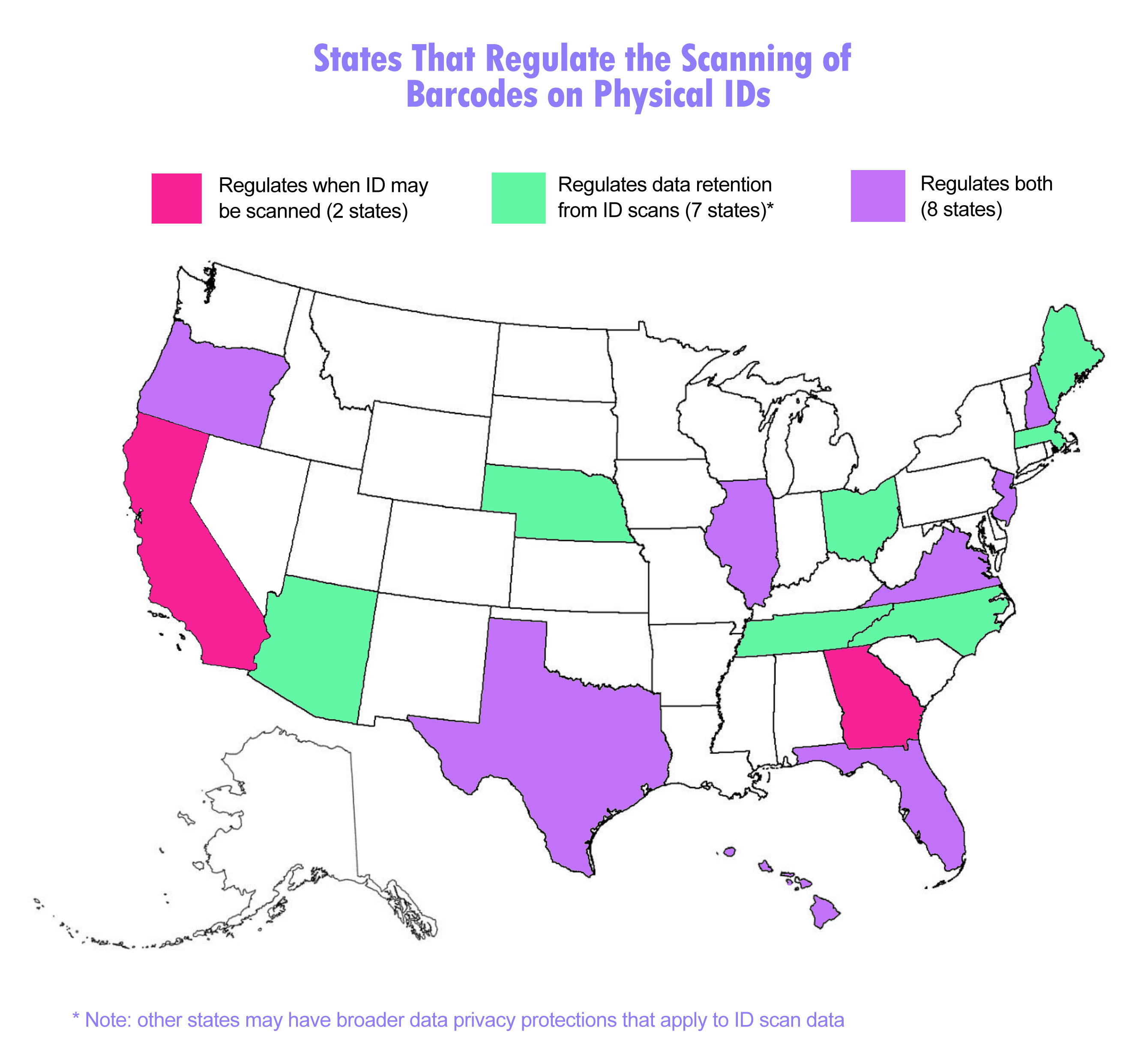
Many of the state laws include exceptions of varying breadth, and are quite weak. Nevertheless, they point toward possibilities for strong protections against omnipresent digital ID demands, which is going to be a much bigger problem with IDs that can be shared online with a single tap or click.
Meanwhile, however, state legislatures are steadily laws enacting digital driver鈥檚 licenses that lack any against omnipresent ID demands 鈥� generally out of naivet茅 that a digital driver鈥檚 license is a simple matter and 鈥渢he future鈥� 鈥� while big tech companies like and , along with the , and the TSA build out the infrastructure for a national digital identity system.
State legislatures need to wake up to this entirely foreseeable consequence of a digital driver鈥檚 licence and protect their constituents.
Learn More About the 老熟女午夜福利 on This Page
-
老熟女午夜福利 & CommentaryJan 2026
Privacy & Technology
Trump Administration Claims Sweeping New Power To Take Down Any Drone It Doesn鈥檛 Like. Explore 老熟女午夜福利 & Commentary.Trump Administration Claims Sweeping New Power to Take Down Any Drone it Doesn鈥檛 Like
Baffling order is likely a move to block drone photography of DHS operations in violation of First Amendment -
老熟女午夜福利 & CommentaryJan 2026
Privacy & Technology
National Security
Government-mandated Software A Looming Threat To Freedom. Explore 老熟女午夜福利 & Commentary.Government-Mandated Software a Looming Threat to Freedom
Trend seen around the world 鈥� and potentially in the US 鈥� opens the door to inescapable censorship and surveillance -
老熟女午夜福利 & CommentaryJan 2026

Privacy & Technology
Retailers Secretively Using Face Recognition To Spot 鈥減ersons Of Interest鈥� 鈥� Including For The Government. Explore 老熟女午夜福利 & Commentary.Retailers Secretively Using Face Recognition to Spot 鈥淧ersons of Interest鈥� 鈥� Including For the Government
Are Wegmans and other retailers participating in the Trump war on immigrants? -
老熟女午夜福利 & CommentaryJan 2026

Privacy & Technology
National Security
Flock Ceo Goes Ballistic On Critics As More Americans Question Mass Driver Surveillance. Explore 老熟女午夜福利 & Commentary.Flock CEO Goes Ballistic on Critics as More Americans Question Mass Driver Surveillance
CEO attacks motives of people who care about privacy, says they are trying to 鈥渘ormalize lawlessness鈥� and 鈥渓et murderers go free鈥�