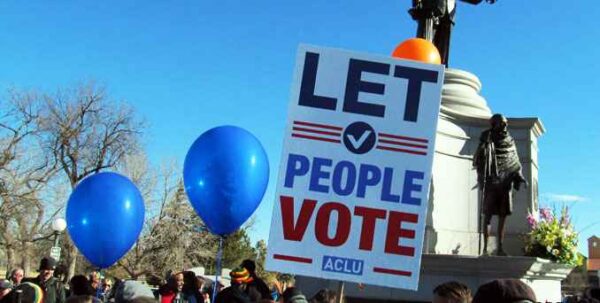
Do you practice safe voting? The ACLU presents its top 10 鈥渟afe voting鈥 tips. Voting is fun and exhilarating, but never to be taken lightly. Be sure to always act safely and responsibly when exercising your right to vote. It鈥檚 how to make your vote count.
If you get an error message while attempting to view this clip, please reload the page or press F5.
Please note that by playing this clip You Tube and Google will place a long-term cookie on your computer. Please see on their website and on theirs to learn more. To view the ACLU's privacy statement, click here
UPDATE: Check out the ACLU's Voter Empowerment Cards for specific information about voting in your home state. Go to www.aclu.org/vec.
Learn More About the 老熟女午夜福利 on This Page
Related Content
-
Press ReleaseDec 2025
Voting Rights
Aclu, Common Cause Take On Trump Administration In Court To Protect Voters鈥 Data. Explore Press Release.ACLU, Common Cause Take on Trump Administration in Court to Protect Voters鈥 Data
Providence, RI 鈥 The 老熟女午夜福利 (ACLU) and ACLU of Rhode Island have intervened, on behalf of Common Cause, in a recently-filed lawsuit to prevent the Department of Justice from obtaining sensitive, non-public information contained in the Rhode Island state voter file. The Department of Justice has requested Rhode Island鈥檚 entire non-public voter file, including the full names, addresses, dates of birth, and driver鈥檚 license numbers and/or social security number information. State officials offered to provide the data that is available to the public, but the Department of Justice sued the State rather than accept. The request is part of a reported effort to assemble a national voter database, which Congress has never authorized, and which could be used to try to disenfranchise voters. The federal government鈥檚 use of this private voter data would also make this sensitive data more vulnerable to hackers and scammers. The groups seek to stop the federal government鈥檚 overreach and misuse of voters鈥 sensitive data, as the federal government does not have a proper purpose for requesting this data. 鈥淩hode Islanders deserve to have their sensitive personal information protected -- not abused by federal authorities,鈥 said Ari Savitzky, senior staff attorney with the ACLU鈥檚 Voting Rights Project. 鈥淭his voter data could be misused to justify large-scale voter purges based on faulty database matching techniques cooked up by election deniers. Federal overreach of this kind threatens voters鈥 privacy and their fundamental right to participate in our democracy.鈥 鈥淧rivacy is essential 鈥 especially as related to a right as fundamental as voting. The Department of Justice has no need for voters鈥 personal information,鈥 said Steven Brown, executive director of the ACLU of RI. 鈥淭his is why we鈥檙e intervening in this case: To protect the rights of Rhode Island voters, and to prevent the potential misuse of Rhode Islanders鈥 data.鈥 鈥淭his dangerous directive puts our sensitive information at risk simply so the Trump Administration can spread election lies,鈥 said John Marion, Common Cause Rhode Island Executive Director. 鈥淗anding this data over to the federal government violates the law. Common Cause is fighting to keep Rhode Islanders safe from senseless data fraud and abuse.鈥 鈥淰oters in Rhode Island and across the country deserve to know that their personal information is secure, protected, and used only for its intended purpose of maintaining accurate voter registration records,鈥 said Maryam Jazini Dorcheh, Senior Director of Litigation at Common Cause. 鈥淲e are committed to defending voters鈥 rights and privacy in Rhode Island and nationwide, and this case is one of many where we are stepping in to ensure those protections are upheld.鈥 A copy of the filing is here: https://assets.aclu.org/live/uploads/2025/12/Motion-to-Intervene-鈥-US-v.-Amore-1.pdfAffiliate: Rhode Island -
South CarolinaDec 2025
Voting Rights
Naacp South Carolina State Conference V. Wilson. Explore Case.NAACP South Carolina State Conference v. Wilson
All voters with disabilities have the right to receive assistance voting from a person of their choice. South Carolina prohibits some voters with disabilities from receiving assistance and limits who voters can rely on for assistance. Voters with disabilities and the NAACP South Carolina State Conference sued to challenge those laws under Section 208 of the Voting Rights Act and protect disabled voters鈥 right to assistance.Status: Ongoing -
Press ReleaseDec 2025
Voting Rights
S.c. Naacp And Disabled Voters Challenge Restrictions On Voter Assistance. Explore Press Release.S.C. NAACP and Disabled Voters Challenge Restrictions on Voter Assistance
COLUMBIA 鈥 Disabled voters are suing to challenge South Carolina鈥檚 restrictions on voter assistance because these laws violate the federal Voting Rights Act and will impede their ability to vote in the 2026 primaries and general election. The lawsuit challenges state laws that have made it difficult or impossible for many disabled South Carolinians, including those living in nursing homes and congregate care facilities, to exercise their voting rights. In a federal lawsuit filed December 5, the NAACP South Carolina State Conference joins individual disabled voters in challenging the State鈥檚 limits on who can provide assistance to voters, how many voters they can assist, and what categories of voters can receive assistance. The Plaintiffs are represented by attorneys from the 老熟女午夜福利, ACLU of South Carolina, and Proskauer Rose LLP. South Carolinians require assistance voting for a variety of reasons including vision and hearing impairments, mobility issues, and cognitive impairments. In the lawsuit, voters rely on Section 208 of the federal Voting Rights Act, which states, 鈥淎ny voter who requires assistance to vote by reason of blindness, disability, or inability to read or write may be given assistance by a person of the voter鈥檚 choice, other than the voter鈥檚 employer or agent of that employer or officer or agent of the voter鈥檚 union.鈥 Congress added Section 208 to the Voting Rights Act in 1982, finding that allowing disabled voters to choose their preferred assistor was 鈥渢he only way to assure meaningful voting assistance and to avoid possible intimidation or manipulation of the voter.鈥 It also found that the denial of assistance to low-literacy voters would conflict with the Voting Rights Act鈥檚 prohibition on literacy tests, which were long used to disenfranchise Black voters. South Carolina law restricts who can provide and receive voting assistance and imposes felony criminal penalties on those who assist in the voting process in violation of the State鈥檚 restrictions. The lawsuit challenges those State laws under the Supremacy Clause of the U.S. Constitution, arguing that they violate Section 208 of the Voting Rights Act. 鈥淰oting is a fundamental right, and the State of South Carolina is infringing on that right for voters with disabilities and low literacy,鈥 said Brenda Murphy, President of the NAACP South Carolina State Conference. 鈥淭he South Carolina NAACP is proud to take part in this important lawsuit to dismantle barriers to voting for Black voters and all voters in our state.鈥 "The Voting Rights Act guarantees for all disabled and low-literacy voters the right to receive assistance from a person of their choice,鈥 said Clay Pierce, EJW Fellow with the ACLU's Voting Rights Project. 鈥淟aws that criminalize that assistance 鈥 from a friend, loved one, or caregiver 鈥 prevent voters from participating in the democratic process with dignity and autonomy. We are proud to represent the NAACP South Carolina State Conference and individual voters to protect their right to assistance." 鈥淭hese laws target some of our state鈥檚 most vulnerable voters and make it harder 鈥 sometimes even impossible 鈥攖o cast a ballot,鈥 said Allen Chaney, Legal Director of the 老熟女午夜福利 of South Carolina. 鈥淰oters who need help voting deserve to receive that help from someone they trust, without worrying that the state might arrest the person they choose.鈥 The Voting Rights Act guarantees disabled and low-literacy voters the right to receive assistance from a person of their choice. The lawsuit asks a federal court to block enforcement of the following state-level restrictions on voter assistance, citing the Voting Rights Act and the Supremacy Clause of the U.S. Constitution: Who is eligible to receive assistance. South Carolina law prohibits voting assistance 鈥渙f any kind鈥 except for 鈥渢hose persons who are unable to read or write or who are physically unable or incapacitated from preparing a ballot or voting.鈥 This rule is narrower than the federal Voting Rights Act, which guarantees assistance for all voters with disabilities. The ability of non-family members to assist voters. State law makes it a felony for many disabled voters to rely on anyone other than a member of their 鈥渋mmediate family鈥 to request or return their absentee ballot. Data from the U.S. Election Assistance Commission shows that, among disabled voters who rely on assistance to vote, a majority prefer to rely on a non-family member to assist them. South Carolina voters are only allowed to rely on an 鈥渁uthorized representative鈥 outside their immediate family in specific circumstances, including if they are confined to home or physically incapable of accessing polling places. Who is authorized to assist with voting. The Voting Rights Act guarantees that voters with disabilities may choose anyone to assist them, with only two narrow exceptions related to their employer or union. In contrast, South Carolina law imposes additional restrictions, including the requirement that an authorized representative is registered to vote in South Carolina. How many voters a person can assist. South Carolina law prohibits anyone from requesting more than five absentee ballot applications or returning more than five absentee ballots for others. This rule harms voters at nursing homes and other congregate care facilities, where many residents often seek assistance from a single social worker or other employee, and violates voters鈥 federal right to rely on an assistor of their choice. The lead plaintiff in the case is the NAACP South Carolina State Conference. The organization is joined by individual plaintiffs who are impeded in their ability to rely on their chosen assistor to vote in the 2026 primary and general elections. They are residents of congregate care facilities who would choose a staff member from the facility whom they trust to assist them, but are impeded by the State鈥檚 five-voter limits for assistors and other restrictions. Defendants in the case include South Carolina Attorney General Alan Wilson, State Election Commission Interim Executive Director Jenny Wooten, State Election Commission Chairman Dennis W. Shedd, and four Members of the State Election Commission, sued in their official capacities. The lawsuit seeks a permanent injunction of the State鈥檚 unlawful restrictions on voting assistance. Plaintiffs filed the case in the U.S. District Court for the District of South Carolina, Columbia Division. A copy of the lawsuit is here: https://assets.aclu.org/live/uploads/2025/12/251205scnaacp-v-wilson-complaint-stamped.pdfAffiliate: South Carolina -
CaliforniaNov 2025
Voting Rights
United States V. Page. Explore Case.United States v. Page
Representing the League of Women Voters of California, the League of Women Voters of Orange Coast, and the League of Women Voters of North Orange County, the ACLU Voting Rights Project, ACLU of Northern California, and ACLU of Southern California have filed a motion to intervene in a federal lawsuit over the federal government鈥檚 demand that Orange County, California turn over unredacted voter information, including voters鈥 sensitive personal data such as drivers鈥 license numbers and partial social security numbers.Status: Ongoing